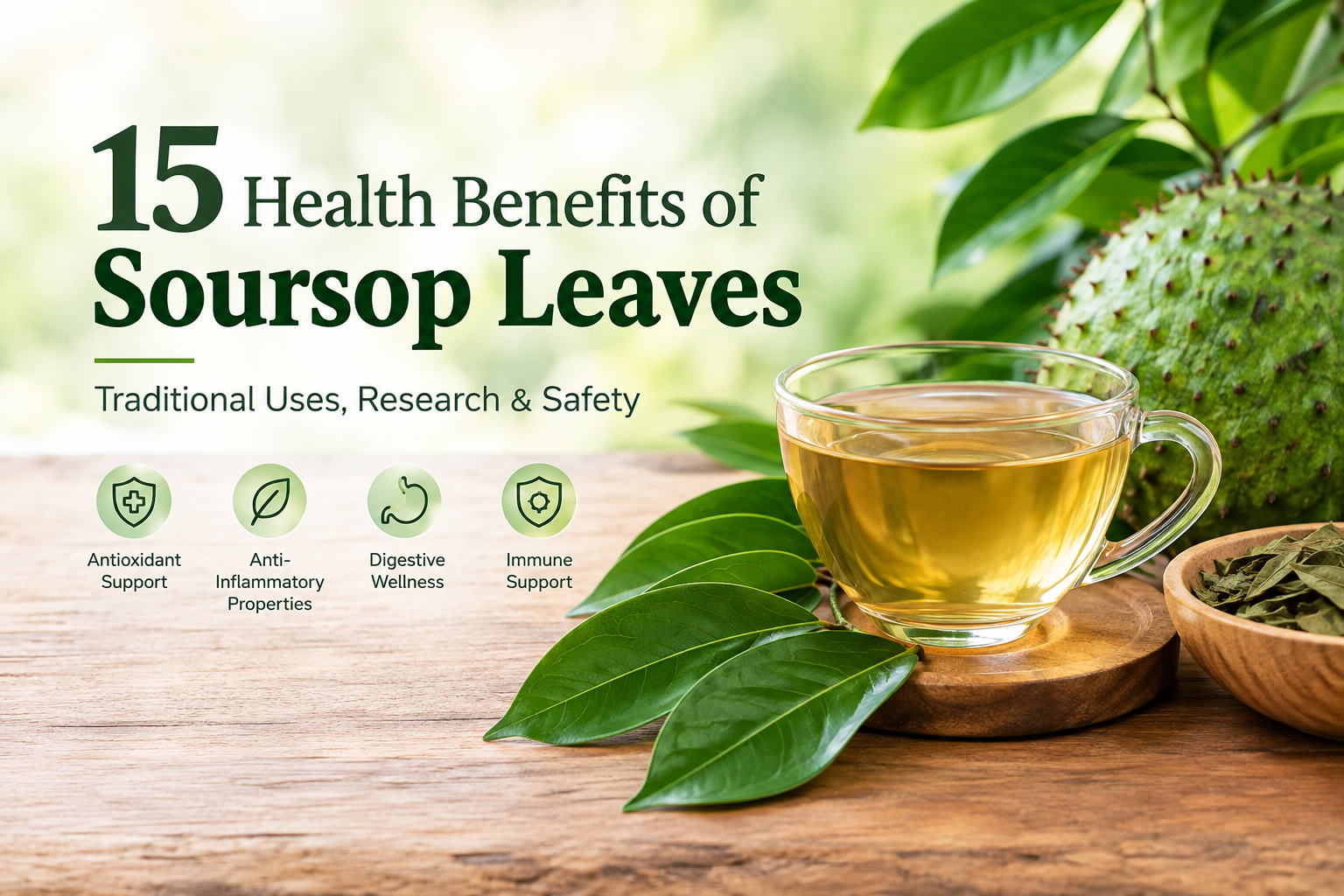
Soursop leaves (Annona muricata) have been used in traditional herbal practices for generations. They are commonly prepared as tea or extracts and are associated with several potential health benefits, including antioxidant activity, inflammation research, and digestive wellness.
However, a professional health article should distinguish between traditional uses, laboratory research, animal studies, and proven benefits in humans. Soursop leaves are not a scientifically established treatment for cancer, diabetes, or other serious diseases.
This article is written in an informative, reader-friendly style, with an emphasis on evidence, responsible health communication, and original explanations rather than exaggerated medical claims.
What Are Soursop Leaves?
Soursop leaves come from the tropical plant Annona muricata, also known as graviola or guanabana. The tree is widely recognized in traditional medicine across tropical regions, where different parts of the plant have been used in home remedies.
Soursop leaves contain several naturally occurring compounds, including acetogenins, alkaloids, and flavonoids. Researchers have investigated these compounds for their biological effects, but chemical activity in a laboratory does not automatically translate into a safe or effective health benefit for people
Why Is Soursop Leaf Tea Popular?
Soursop leaf tea is often prepared by boiling or steeping leaves in water. People may drink it as part of traditional wellness routines, particularly for relaxation, general health, or perceived anti-inflammatory effects.
The important distinction is that traditional use provides context for research; it does not establish that the tea treats a medical condition. Evidence on appropriate preparation, dosage, long-term safety, and effectiveness remains limited.
15 Potential Health Benefits of Soursop Leaves
The following sections explain potential benefits based on research findings and traditional interest. These are research areas, not confirmed medical benefits.
Antioxidant Activity
Soursop leaves contain plant compounds, including phenolic substances and flavonoids, that have demonstrated antioxidant activity in laboratory research.
Antioxidants can interact with free radicals in experimental settings. However, the antioxidant capacity of a leaf extract does not prove that drinking soursop tea prevents disease or produces a measurable health improvement in human
Potential Anti-Inflammatory Effects
Laboratory and animal studies have explored the anti-inflammatory properties of compounds found in Annona muricata.
These findings may help researchers investigate how plant compounds interact with inflammatory pathways. They do not establish that soursop leaf tea treats arthritis, chronic inflammation, or other inflammatory diseases.

Research Into Blood Sugar Regulation
Soursop leaf extracts have shown blood-glucose-lowering effects in certain animal models.
This is an area of interest for metabolic research, but it should not be interpreted as proof that soursop leaves control diabetes in people. Using an extract alongside diabetes medication could also create safety concerns if blood sugar falls too low
Antimicrobial Research
Some soursop compounds and extracts have been investigated for activity against microorganisms in laboratory experiments.
Such findings may support future research into plant-derived antimicrobial substances. They are not evidence that soursop leaf tea can replace antibiotics or reliably treat infections.
Traditional Digestive Wellness
Soursop has a history of traditional medicinal use for digestive complaints. Researchers have also examined anti-ulcerative and gastroprotective effects in preclinical studies.
These results do not establish that soursop leaves improve digestion, cure ulcers, or treat persistent stomach pain in humans. Ongoing symptoms should be assessed by a healthcare professional
Liver Health Research
Some preclinical studies have reported hepatoprotective effects associated with soursop extracts.
These observations may guide further investigation into plant compounds and liver-related biological processes. They do not demonstrate that soursop leaves detoxify the liver or prevent liver disease. The extract’s composition and dose are important when interpreting safety

Anticancer Research Interest
Acetogenins and other soursop compounds have been studied for their effects on cancer cells in laboratory experiments.
This research is scientifically relevant, but soursop leaves have not been proven to cure or treat cancer in humans. Laboratory findings involving concentrated extracts cannot be used to establish a safe cancer treatment or dosage
Possible Antimicrobial Applications
Beyond general antimicrobial screening, researchers have examined soursop-derived substances for activity against different microorganisms.
The potential value is primarily in experimental investigation of plant chemistry. The specific extract, organism, concentration, and test conditions all influence results, so a laboratory effect cannot be treated as a proven household remedy
Investigation of Pain-Related Effects
Reviews of Annona muricata research have identified antinociceptive activity, meaning effects related to pain perception, in preclinical research.
These findings do not establish that soursop leaf tea is a reliable pain reliever. Persistent pain should be investigated rather than self-treated with an unstandardized herbal preparation.
Research Into Blood Pressure Effects
Soursop-related compounds have been studied for possible antihypertensive effects, including in experimental models.
There is insufficient clinical evidence to recommend soursop leaves for managing high blood pressure. People taking blood-pressure medication should consult a clinician before using concentrated herbal products.
Exploration of Immune-Related Activity
Some research on Annona muricata has explored immunomodulatory effects, which means possible changes in immune-system activity.
This does not mean soursop leaves have been shown to strengthen immunity in a clinically meaningful way. Immune responses are complex, and more human research is required to understand any practical benefits
Research Into Skin and Wound Healing
Experimental research has investigated wound-healing activity associated with soursop extracts.
Findings from animal or laboratory studies cannot establish that applying soursop leaf preparations to a wound is safe or effective. Proper wound care and professional evaluation remain important, especially for deep or infected wounds

Potential Gastroprotective Activity
Gastroprotective research examines whether substances may protect stomach tissue under experimental conditions.
Some studies have explored this property in soursop-related extracts. It is not sufficient evidence to recommend the leaves for gastritis, ulcers, or acid reflux. The effects of a homemade tea may differ considerably from those of a tested extract.
Investigation of Cellular Protection
Antioxidant and other biological activities of soursop-derived compounds have encouraged researchers to examine possible cellular effects.
The phrase “cellular protection” should be used carefully. Results from isolated cells or biochemical tests do not establish that consuming the leaves protects human organs or prevents chronic disease

Support for Future Herbal Medicine Research
One of the clearest legitimate benefits of studying soursop leaves is the opportunity to investigate their chemical constituents and biological effects.
Researchers can examine standardized extracts, potential therapeutic mechanisms, drug interactions, and long-term toxicity. This scientific work is necessary before any specific medical use can be recommended confidently.
What Does Scientific Research Actually Say?
A common problem with online herbal-health content is that it presents experimental findings as established human benefits. A more useful approach is to examine what researchers have actually studied.
A 2020 systematic review of Annona muricata leaf extracts and their constituents included 39 studies. Of these, 26 involved animals, 8 were laboratory studies, and 5 were human studies. The review highlighted the limited human evidence and the need for further research into safety and efficacy.
Research Evidence: What to Understand
| Research area | What the evidence indicates |
|---|---|
| Antioxidant activity | Observed in laboratory research |
| Anti-inflammatory effects | Investigated in preclinical studies |
| Blood sugar | Effects reported in some animal models |
| Anticancer activity | Laboratory and preclinical research; not a proven human treatment |
| Long-term safety | Not adequately established |
| Standard dosage | No clinically established dosage for general health |
The distinction between a laboratory result and a clinical benefit is particularly important when writing health content. A plant can contain biologically active compounds without being suitable for regular medicinal use.
Soursop Leaf Tea: Is It Safe?
Soursop leaf tea is a traditional preparation, but natural does not automatically mean risk-free. The chemical composition of the tea can vary depending on the plant material, preparation method, concentration, and amount consumed.
A systematic review reported limited human safety data and discussed potential neurological toxicity associated with certain soursop compounds, including acetogenins. Drugs.com also notes concerns about neurological effects and advises people with established Parkinson disease to avoid soursop fruit or leaf decoctions
Possible Safety Concerns
- Neurological effects: Certain compounds have raised concerns about neurotoxicity in preclinical research.
- Blood sugar: Extracts may affect glucose levels, creating potential concerns for people using diabetes medication.
- Drug interactions: Herbal products may interact with medicines, and evidence on specific interactions is incomplete.
- Pregnancy and breastfeeding: Safety is not sufficiently established, so medical advice is important before use.
- Concentrated supplements: Capsules and extracts are not equivalent to a mild food preparation and may expose users to different quantities of active compounds.
Do not use soursop leaves as a replacement for prescribed treatment. If you have a medical condition or take regular medication, discuss use with a qualified healthcare professional.
How to Approach Soursop Leaves Responsibly
There is no universally established medicinal dosage for soursop leaf tea or extracts. Research findings cannot be converted into a reliable homemade tea recipe because preparations differ in concentration and composition.
For a health-focused article, the responsible message is simple: readers should avoid assuming that more tea or a stronger extract will produce greater health benefits. Further clinical research is needed to determine effective amounts and long-term safety.
Frequently Asked Questions
What are soursop leaves commonly used for?
Can soursop leaves cure cancer?
Can I drink soursop leaf tea every day?
Do soursop leaves lower blood sugar?
Are soursop leaves safe for everyone?
Conclusion
Soursop leaves are an interesting subject in traditional medicine and plant-based research. Their naturally occurring compounds have been investigated for several biological activities, but there is not enough high-quality human evidence to confirm 15 specific health benefits.
A trustworthy article should avoid promising disease prevention or treatment based only on laboratory findings. The most valuable contribution is to explain the research honestly, recognize uncertainty, and help readers make informed decisions about herbal products.
Soursop leaf research may offer opportunities for future scientific investigation, but more carefully designed human studies are needed before strong medical recommendations