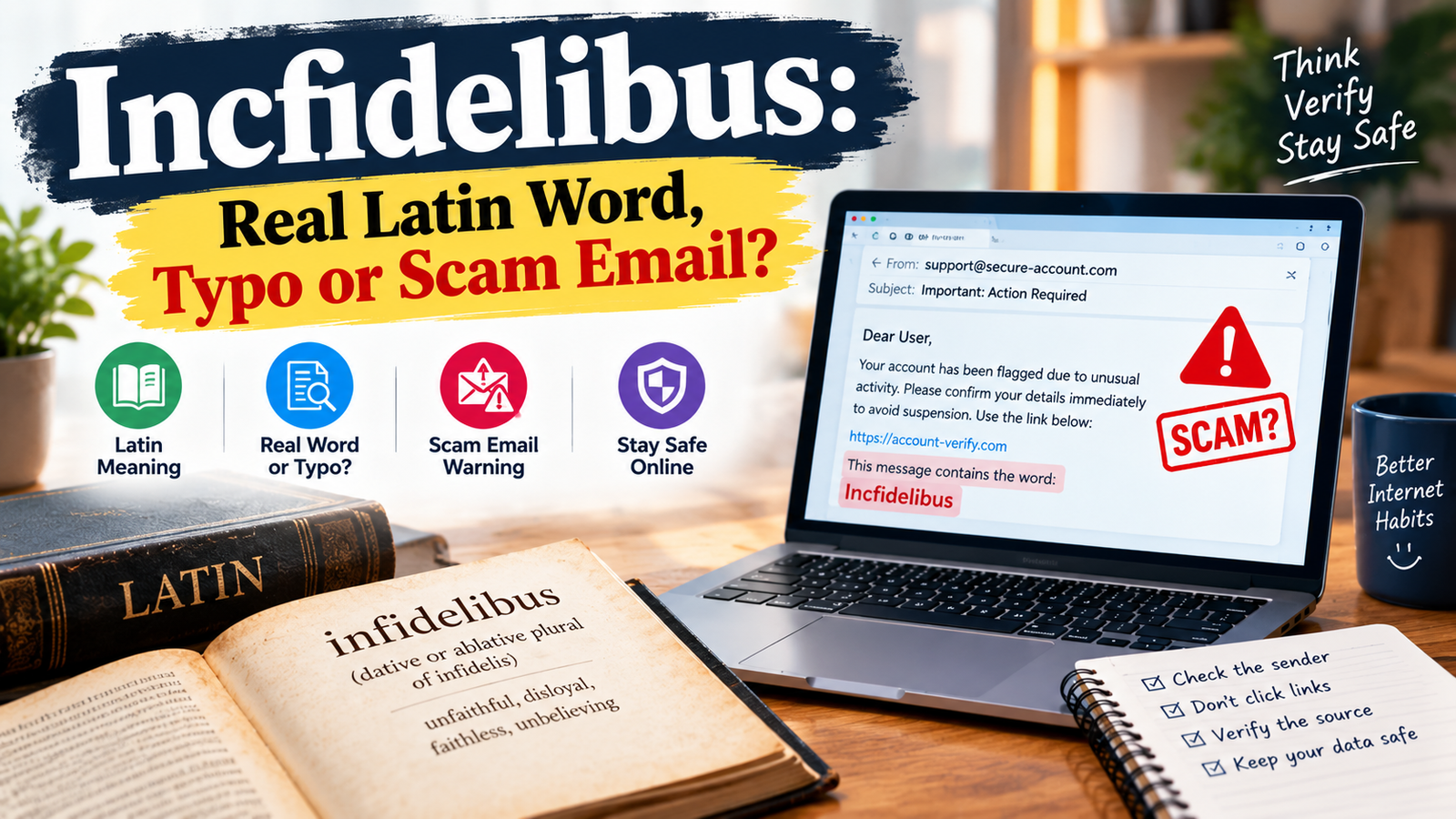
Seeing an unfamiliar word in an email can create an instant sense of danger. Incfidelibus is a good example because it looks old, formal, and almost certainly Latin, yet its exact status is much less mysterious than its appearance suggests.
The key point is simple: incfidelibus is not established as a standard Latin word in the references available today. It closely resembles infidelibus, which is a genuine Latin form connected to infidelis. Latin references identify infidelibus as the dative or ablative plural form of infidelis, with meanings related to being unfaithful, disloyal, faithless, or unbelieving depending on context.
That distinction matters if you found incfidelibus in a suspicious email. The word itself does not prove that an email is malicious. The sender, links, attachments, requests, and overall message behavior are much more important.
Table of Contents
- What Is Incfidelibus?
- Is Incfidelibus a Real Latin Word?
- Incfidelibus vs. Infidelibus
- Why Does the Word Look So Convincing?
- Can Incfidelibus Appear in a Scam Email?
- How Fear Tactics Work in Phishing
- Common Signs of a Suspicious Email
- What to Do If You Receive an Incfidelibus Email
- Why Searching in Panic Can Make Things Worse
- The Useful Lesson Behind a Strange Word
- How to Explain the Issue to Family and Friends
- Incfidelibus and Online Trust
- Frequently Asked Questions
- Final Thoughts
What Is Incfidelibus?
Incfidelibus is best treated as an unusual or non-standard spelling rather than a confirmed standalone Latin word. Current explanations consistently point toward infidelibus, the documented Latin form without the extra “c.”
That one-letter difference is responsible for much of the confusion. When a word looks like it belongs to an ancient language, readers naturally assume it must have a precise historical meaning. Search engines can make that impression even stronger because a misspelling can appear across multiple copied or newly published pages.
The safer approach is to separate what can be verified from what is merely repeated online. There is evidence for infidelibus as a genuine Latin form. There is not comparable evidence establishing incfidelibus as an independent classical Latin term.
Is Incfidelibus a Real Latin Word?
The short answer is not as a standard Latin form based on the references currently available.
The documented word is infidelibus, which appears in Latin dictionaries and grammatical references. It is the dative or ablative plural form of infidelis, a third-declension adjective.
This is an important distinction because the internet often treats repeated information as proof. A word appearing on ten websites does not automatically make it historically authentic. Search results can contain copied articles, SEO pages, OCR errors, user-generated content, and modern inventions.
For anyone researching Latin, manuscripts, theology, or historical texts, the original source should always carry more weight than a modern page that simply defines the term.
Incfidelibus vs. Infidelibus
The easiest way to understand the issue is to remove the extra letter and examine the word underneath it.
| Term | Status | General explanation |
|---|---|---|
| fidelis | Established Latin | Faithful, loyal |
| infidelis | Established Latin | Unfaithful, disloyal, unbelieving |
| infidelibus | Established Latin form | Dative/ablative plural of infidelis |
| incfidelibus | Non-standard/uncertain | Latin-looking form closely resembling infidelibus |
The difference may look tiny, but it changes the linguistic status of the word. Infidelibus is supported by Latin dictionary resources and historical usage, while the spelling incfidelibus is not established in the same way.
What Does Infidelibus Mean?
Understanding infidelibus provides the clearest explanation for why incfidelibus looks meaningful.
The base adjective infidelis can express ideas such as unfaithful, faithless, disloyal, treacherous, or unbelieving. The exact translation depends on the context in which the Latin appears.
The ending -ibus is also significant. It marks the dative or ablative plural for this type of Latin adjective. As a result, infidelibus cannot always be translated into one fixed English word. Its surrounding sentence determines whether an English translation should use ideas such as “to,” “for,” “with,” or “by.”
So if someone claims that incfidelibus has one secret or universal translation, that deserves caution.
Why Does the Word Look So Convincing?
The strongest reason for the confusion is its structure.
Words ending in -ibus often look distinctly Latin to modern readers. Combine that ending with fidel and the result appears scholarly, religious, or historical even if the spelling itself is wrong.
That visual authority can influence how people react to the word. A strange term printed inside an ordinary sentence may seem harmless, while the same term inside an alarming email can suddenly feel like a technical warning.
This is where language and cybersecurity overlap. A word can look authoritative without actually providing evidence that a message is legitimate.
Can Incfidelibus Appear in a Scam Email?
It is possible to encounter unusual or unfamiliar words in suspicious emails, but the presence of incfidelibus alone does not prove that an email is a scam.
Some current online discussions specifically connect the search term with suspicious-message or spam-email concerns. However, those claims should not be confused with proof that every message containing the word comes from the same campaign or threat actor.
The practical question is therefore not simply, “Why did I receive this word?”
The better question is, “What is this email trying to make me do?”
If the message asks you to click a link, open an unexpected attachment, reveal a password, confirm financial information, pay an invoice, or act immediately, those behaviors deserve far more attention than the unusual vocabulary.
The FTC specifically warns that phishing messages often impersonate trusted organizations and pressure recipients into clicking links, opening attachments, or providing sensitive information.
How Fear Tactics Work in Phishing
Fear is one of the simplest ways to make people act before they think.
A suspicious email might suggest that an account has been compromised, a payment has failed, a legal problem is waiting, or an important service will be terminated. The unfamiliar word then becomes part of a larger story designed to make the recipient feel that something serious is happening.
That is why incfidelibus should not be evaluated in isolation.
A strange word is just a strange word. The real warning signs come from the combination of urgency, impersonation, suspicious links, unexpected attachments, requests for private information, and pressure to act immediately.
CISA similarly advises people to be wary of messages that demand immediate action or request personally identifiable information.
Common Signs of a Suspicious Email
A strange email deserves extra attention when several warning signs appear together.
- Unexpected request: You were not expecting the message, invoice, account alert, or document.
- Urgency or threats: The sender says you must act immediately or face consequences.
- Suspicious link: The visible text looks normal but the actual destination is unfamiliar.
- Sensitive information request: The message asks for passwords, banking details, verification codes, or identity information.
- Unexpected attachment: You are encouraged to open a file you were not expecting.
- Sender mismatch: The displayed sender name appears familiar but the actual email address does not match the organization.
The FTC recommends avoiding links and attachments in unexpected messages and independently contacting the supposed organization through a website or phone number you already know to be legitimate.
What to Do If You Receive an Incfidelibus Email
The smartest response is to slow down before interacting with the message.
First, do not click anything simply because the email looks urgent. Do not download an attachment just to discover what it contains, and do not reply with personal information.
Next, examine the sender address and the purpose of the message. If it claims to come from your bank, employer, payment provider, government agency, or another company, open that organization’s website independently rather than using the email’s link.
If the message is clearly suspicious, mark it as spam or phishing and delete it after reporting it through the appropriate channel. The FTC recommends reporting phishing attempts and provides reporting options for suspicious emails.
If you already clicked something, do not assume that nothing happened simply because you did not see an obvious warning. Update your security software, run a scan where appropriate, and change passwords if you believe your credentials may have been exposed. The FTC recommends updating security software and using two-factor authentication after a suspected malware or credential compromise.
Why You Should Not Search in a Panic
Searching for an unfamiliar word is normally a good idea. Searching while frightened can be a different experience.
When people are worried, they often click the first dramatic result they see. That can lead from one confusing page to another and make a simple spelling question feel like evidence of a major security incident.
A better research method is to slow down and compare information.
Look at the spelling. Check whether the word appears in reliable language references. Examine the surrounding email separately. Then investigate the sender, domain, links, and requested action.
This approach separates the meaning of a word from the behavior of the message.
The Surprising Benefit of a Strange Word
An unfamiliar term can actually be useful because it gives you a reason to pause.
That pause is valuable. Scammers often depend on speed. The faster someone clicks, replies, pays, or submits information, the less opportunity that person has to verify what is happening.
In this sense, incfidelibus can become a reminder to investigate rather than a reason to panic.
If a message contains a word you do not recognize, stop and ask why the sender used it. Then verify the rest of the message independently.
The goal is not to become suspicious of every unusual word. The goal is to become comfortable with saying, “I need to verify this first.”
How Scammers Use Confusion as a Tool
Confusion can make an ordinary message feel more important than it really is.
A scammer may combine official-looking formatting, unfamiliar terminology, logos, urgent language, and a request for immediate action. The recipient does not necessarily need to understand every detail. The uncertainty itself can create pressure.
The FTC notes that phishing messages frequently imitate organizations people know and trust, while CISA warns about urgent requests and suspicious hyperlinks.
That is why the strongest defense is not memorizing every suspicious keyword.
It is learning to recognize the behavioral pattern behind the message.
How to Talk About This With Family or Friends
The easiest way to explain the issue to someone else is to avoid making the unusual word sound frightening.
Tell them that incfidelibus appears to be a non-standard spelling closely associated online with the real Latin form infidelibus. Then explain that seeing the word in an email does not automatically prove that the message is malicious.
What matters is what the email requests.
If it asks for passwords, financial information, verification codes, remote access, payment, or an urgent click, the message should be independently verified before anything is done.
This is especially useful when helping relatives who may feel uncomfortable admitting that an email confused them. The best security habit is not knowing every technical term. It is knowing when to stop and ask for help.
Incfidelibus and the Bigger Lesson About Online Trust
The most interesting part of the incfidelibus search is not the strange spelling itself. It is how quickly an unfamiliar term can acquire authority online.
A page can confidently define a word. Another page can repeat that definition. A third can build a completely different story around it. Eventually, repetition can look like evidence.
That is why trustworthy research requires more than counting search results.
For language questions, check dictionaries and historical sources. For cybersecurity questions, check established security guidance. For an email claiming to represent a company, verify the company independently.
The same principle applies everywhere online: do not confuse confidence with evidence.
A Simple Way to Evaluate an Incfidelibus Search Result
When researching the term, start with the spelling itself. If you meant infidelibus, the documented Latin form can be investigated through Latin dictionaries and grammatical references.
Then consider the context in which you encountered incfidelibus. A historical document, search result, social-media post, and suspicious email require different levels of verification.
Finally, separate facts from assumptions. The fact that the spelling looks Latin does not prove that it is a historical Latin word. Likewise, the fact that some pages associate it with scam emails does not mean every occurrence is malicious.
That simple distinction makes the entire topic much easier to understand.
Frequently Asked Questions
What does incfidelibus mean?
Incfidelibus does not have a securely established independent meaning as a standard Latin word. It closely resembles infidelibus, a documented Latin form derived from infidelis.
Is incfidelibus a real Latin word?
The spelling incfidelibus is not established as a standard Latin form in the references reviewed. The documented form is infidelibus, without the extra “c.”
What does infidelibus mean?
Infidelibus is the dative or ablative plural of infidelis. Depending on context, it can relate to ideas such as “to the unfaithful,” “for the unfaithful,” or “among/by the unbelieving.”
Why does incfidelibus look like Latin?
Its structure closely resembles the genuine Latin form infidelibus, including the recognizable -ibus ending. That visual similarity can make the unusual spelling appear more historically established than it actually is.
Is an incfidelibus email automatically a scam?
No. The word alone cannot establish that an email is fraudulent. Look at the sender, links, attachments, urgency, requested information, and whether the message asks you to perform an unexpected action.
What should I do if I receive a suspicious email?
Do not click unexpected links or attachments. Verify the supposed sender independently, report the message as phishing or spam, and delete it. If you already supplied sensitive information, take account-security steps promptly.
Is the extra “c” meaningful?
There is no established Latin grammatical explanation showing that the extra c creates a separate standard word. Current references instead treat incfidelibus as a non-standard form associated with infidelibus.
Final Thoughts
Incfidelibus is more confusing than dangerous as a word. Its unusual spelling makes it look like an ancient or technical expression, but the stronger linguistic evidence points toward infidelibus, the genuine Latin form without the extra “c.”
If you encountered incfidelibus in an email, however, the linguistic question should come second. Check the message itself. Do not click unfamiliar links, open unexpected attachments, share sensitive information, or let urgent language force you into a quick decision. Those are the practical lessons that matter most.
The bigger takeaway is simple: an unfamiliar word deserves curiosity, not panic. Verify the language, verify the source, and verify the request before you trust what appears on your screen.