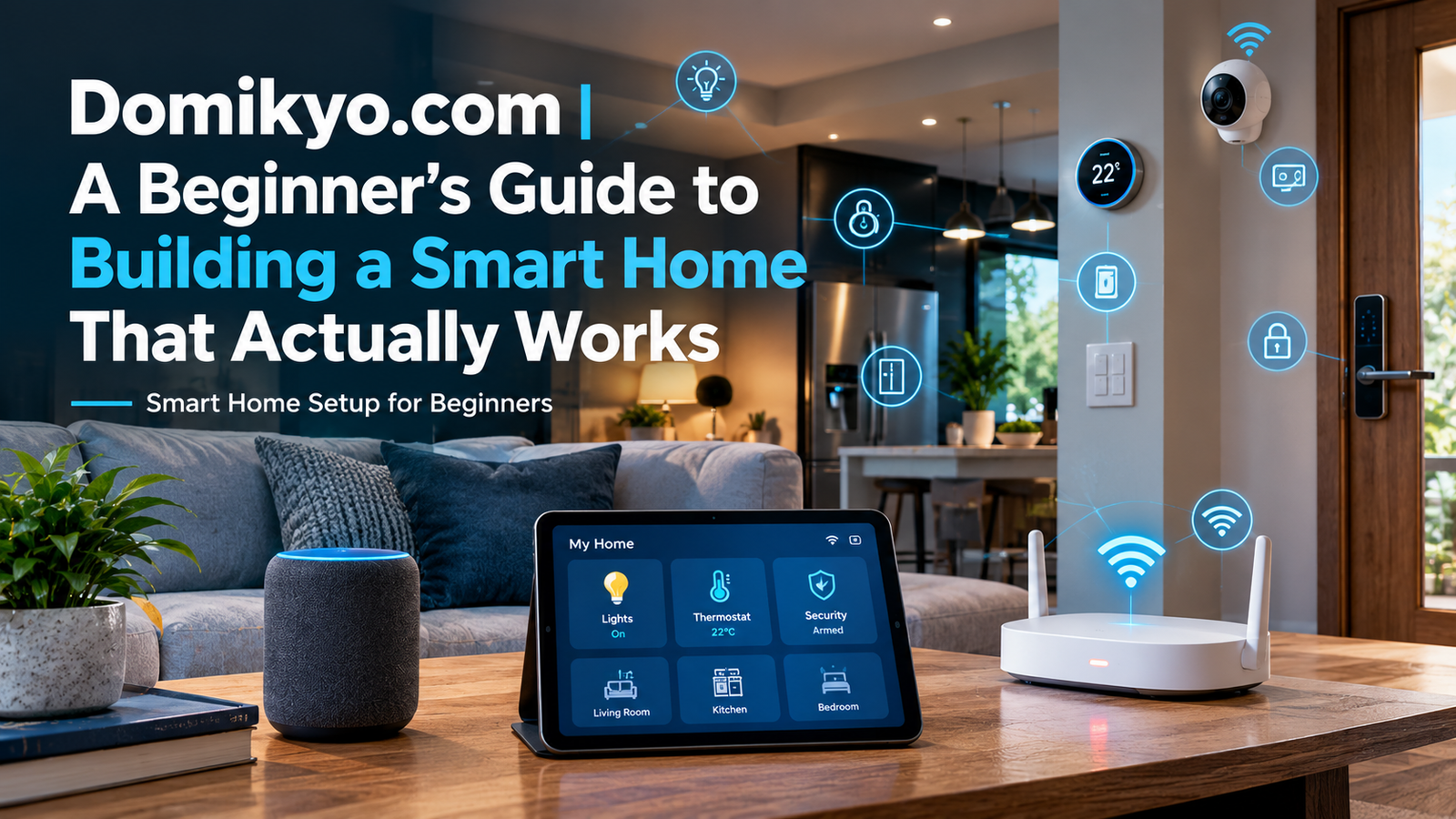
A smart home sounds effortless when you see it in an advertisement: lights turn on automatically, the thermostat adjusts itself, cameras send instant alerts, and every device responds to one simple command. In reality, getting all of those devices to work together can be much harder, especially for someone buying their first smart-home products.
That is where Domikyo.com enters the conversation. Current online references associate Domikyo with technology, smart-home systems, IoT, networking, connected devices, cybersecurity, and digital living. Other descriptions present the website more broadly as an information platform covering technology and several general-interest subjects.
For beginners, the more useful question is not simply what device to buy. It is how to build a connected home that remains reliable after the excitement of the first few installations disappears.
Table of Contents
- What Is Domikyo.com?
- Why Smart Homes Become Complicated
- The Network Behind Every Smart Home
- Wi-Fi Problems Beginners Often Miss
- A Realistic Smart-Home Starting Point
- Matter and Thread Explained Simply
- Smart-Home Security and Privacy
- Why More Devices Can Create More Problems
- How Domikyo.com Can Help Beginners
- A Practical Smart-Home Plan
- What a Good Smart-Home Guide Should Explain
- Frequently Asked Questions
- Final Thoughts
What Is Domikyo.com?
Domikyo.com is best understood as an online information platform associated with technology and connected living, rather than a smart-home device manufacturer or a single hardware product. Recent third-party coverage repeatedly connects the domain with smart-home technology, IoT, home networking, device integration, and digital security, while other descriptions give it a broader technology and general-information focus.
That distinction matters for anyone searching for Domikyo because the name itself can create the impression that it is a particular smart-home system. The available public information instead points toward an educational and informational role.
The strongest value of this type of resource is helping ordinary users understand technology before they start spending money on it. A homeowner does not necessarily need to understand networking terminology or wireless protocols, but knowing the basics can prevent expensive compatibility and connectivity mistakes.
Why Smart Homes Become Complicated
The first smart-home mistake is often buying devices before deciding how those devices will communicate. A smart bulb may work perfectly on its own, yet the experience can become frustrating when several devices from different brands use different apps, ecosystems, connectivity standards, or setup requirements.
Imagine starting with smart lights. Then you add a video doorbell, smart lock, thermostat, security camera, voice assistant, plugs, and sensors. Each product may promise simple installation, but the combined system can become surprisingly complicated.
That is why a beginner should think about the home as a connected system rather than a collection of individual gadgets.
The goal is not to own the largest number of smart devices. The goal is to make useful automation work consistently.
The Network Behind Every Smart Home
A reliable network is the foundation of a reliable smart home. Smart devices depend on communication between the device, router, local network, cloud services, apps, hubs, or other connected equipment.
If the network is unstable, even an expensive smart lock or camera can feel unreliable.
Home networking problems can come from weak Wi-Fi coverage, router placement, congestion, interference, outdated equipment, or simply having more connected devices than the network handles comfortably.
This is one reason current material associated with Domikyo places attention on networking alongside smart-home technology.
Wi-Fi Problems Beginners Often Miss
A strong internet plan does not automatically mean strong Wi-Fi throughout the house. Your internet provider may deliver excellent speeds to the router, while a bedroom, garage, basement, or outdoor camera location receives a weak signal.
The distinction between internet speed and Wi-Fi coverage is important.
A smart-home device usually needs a stable connection more than it needs extremely high download speeds. A temperature sensor does not require the same bandwidth as a 4K streaming television, but it still needs dependable communication.
Before adding more smart devices, check where your router is positioned and whether important areas of the home receive a consistent signal.
A Realistic Smart-Home Starting Point
The smartest way to begin is small. A beginner does not need to automate the entire house during the first weekend.
Start with one useful problem. Perhaps you want lights to switch off automatically at bedtime, a camera to notify you about movement, or a smart thermostat to follow a schedule.
Once that setup works reliably, add another device.
This approach makes troubleshooting much easier because you know what changed when something stops working.
A sensible beginner setup can focus on:
- One ecosystem: Choose a platform that works well with the phones and devices your household already uses.
- A few useful devices: Start with lights, plugs, sensors, or another product that solves a genuine problem.
- Reliable networking: Make sure the devices have dependable Wi-Fi or another appropriate connection.
- Basic security: Change default credentials, enable available security protections, and keep software updated.
The objective is simple: build a smart home that makes everyday life easier instead of creating another technology project to manage.
Matter and Thread Explained Simply
Matter and Thread can sound complicated, but beginners do not need to become networking experts to understand their basic purpose.
Matter is a smart-home interoperability standard designed to help compatible devices work across supported ecosystems. Thread, meanwhile, is a low-power mesh networking technology designed for connected devices such as sensors, lights, and other smart-home equipment.
The important point is that Matter and Thread are not identical things.
Matter describes how compatible smart-home devices can communicate at the application level, while Thread is one type of networking technology that can carry smart-home communication.
For a buyer, compatibility still needs to be checked carefully. A product saying “Matter compatible” does not mean every feature will work identically across every platform.
That is why checking the manufacturer’s current compatibility information before purchasing remains important.
Smart-Home Security and Privacy
Convenience should never come at the cost of basic security. A connected camera, smart lock, speaker, thermostat, or appliance can potentially collect information or communicate through your home network.
Security therefore needs to be part of the setup from day one.
Use strong, unique passwords for important accounts, enable two-factor authentication when supported, install firmware and application updates, and review the permissions requested by companion apps.
Network separation can also be useful. Some advanced users place smart devices on a separate guest or IoT network so that connected gadgets have less direct access to computers and personal devices.
Current discussions surrounding Domikyo and smart-home technology also emphasize cybersecurity and privacy as part of connected living rather than treating security as an optional extra.
Passwords Are Important, But Not Enough
A strong password is only one layer of protection. Security also depends on software updates, account protection, router security, device settings, and the manufacturer’s approach to maintaining the product.
This becomes particularly important with devices that remain connected to the internet continuously.
A smart-home owner should therefore ask a simple question before purchasing: Will this product still be supported and updated after I install it?
A cheap device that receives no meaningful security updates may become a poor long-term purchase even if it works perfectly on day one.
Why More Devices Can Create More Problems
More automation does not automatically mean a smarter home. Every additional device introduces another account, application, firmware version, connection, permission setting, and possible point of failure.
Consider a simple morning routine. A motion sensor triggers lights, the thermostat follows a schedule, a smart speaker plays music, and a security system changes modes. It sounds impressive until one device loses connection and the entire routine behaves unexpectedly.
This is why reliability should be valued over novelty.
A smaller system that works every morning can be much more useful than a huge collection of devices that requires constant troubleshooting.
How Domikyo.com Can Help Beginners
The most useful role for Domikyo.com is as a starting point for understanding connected technology before making decisions. Recent online descriptions specifically associate the domain with smart-home basics, IoT integration, networking, cybersecurity, and practical technology information.
A beginner can use this type of content to understand terminology, compare approaches, identify potential compatibility issues, and learn why a smart-home setup may fail.
However, readers should still verify important product specifications and setup instructions through the manufacturer’s official documentation.
That is especially important because smart-home platforms change quickly. Firmware updates, app interfaces, supported ecosystems, subscription policies, and compatibility lists can change after an article has been published.
A Practical Smart-Home Plan
The easiest way to avoid unnecessary frustration is to plan before purchasing. Instead of searching for the newest gadget first, decide what you actually want your home to do.
Step 1: Identify the Problem
Do you want better lighting, improved security, energy savings, convenience, or simple automation?
A clear goal prevents unnecessary purchases.
Step 2: Choose Your Ecosystem
Look at the phones, voice assistants, hubs, and other technology already used in your household. Compatibility becomes much easier when new products fit your existing setup.
Step 3: Check Connectivity
Determine whether a device uses Wi-Fi, Bluetooth, Thread, Zigbee, or another connection. Then confirm that your existing equipment supports it.
Step 4: Secure Everything
Before expanding the system, update the firmware, protect accounts, enable available security features, and review privacy settings.
Step 5: Expand Slowly
Once the first few devices work properly, add new equipment one piece at a time. This makes the entire system easier to understand and maintain.
What a Good Smart-Home Guide Should Explain
A genuinely helpful technology guide should solve the beginner’s problem, not simply repeat product specifications.
Good smart-home content explains why a technology matters, where it works, what its limitations are, and what could go wrong.
It should also distinguish between facts, recommendations, and personal opinions.
For example, telling someone that a device supports Wi-Fi is useful. Explaining whether their existing router is likely to support it reliably is much more useful.
The same principle applies to security. Saying “use a strong password” is basic advice. Explaining account protection, software updates, network segmentation, privacy permissions, and device support gives the reader a much more complete understanding.
Domikyo.com and the Future of Connected Homes
Smart homes are moving toward greater interoperability, automation, and intelligence. The combination of IoT devices, sensors, AI-powered software, voice interfaces, energy-management systems, and standards such as Matter is changing what consumers expect from connected homes.
But convenience will only matter if these systems become easier to use.
The future smart home should not require homeowners to understand every networking protocol behind the scenes. Ideally, devices should communicate more naturally while giving users clear control over privacy, security, data, and automation.
That is why educational content around connected technology remains valuable. People need to understand what they are buying before the technology becomes invisible in their everyday lives.
Frequently Asked Questions
What is Domikyo.com?
Domikyo.com is an online information platform associated with technology, smart-home systems, IoT, networking, cybersecurity, and digital living. Other current descriptions also associate the broader site with topics such as business, finance, health, lifestyle, education, and travel.
Is Domikyo.com a smart-home product?
No clear evidence from the current public sources indicates that Domikyo.com is itself a smart-home hardware product or standalone application. It is primarily described as a website or online information platform.
What does Domikyo.com cover?
The strongest current association is with smart-home technology, IoT, networking, connected devices, cybersecurity, and digital trends. Some sources describe a wider range of categories, so the site’s exact editorial mix may change over time.
Is smart-home technology difficult for beginners?
It can be confusing at first because devices use different ecosystems, networks, apps, and compatibility standards. Starting with a small number of compatible devices and building from a reliable network makes the learning process much easier.
What is Matter in smart-home technology?
Matter is an interoperability standard designed to help compatible smart-home devices communicate across supported ecosystems. It is different from Thread, which is a networking technology that can be used by compatible smart-home devices.
How can I make my smart home more secure?
Use strong unique passwords, enable two-factor authentication where available, keep device firmware and apps updated, secure your router, review privacy settings, and consider separating IoT devices from important personal devices on your home network.
Should I buy many smart devices at once?
Usually, no. Building gradually allows you to identify compatibility problems and understand how each device affects your network and automation routines before expanding the system.
Final Thoughts
The real value of a smart home is not the number of gadgets inside it—it is how naturally those gadgets improve everyday life.
Domikyo.com is associated with the growing need for understandable information about smart homes, IoT, networking, cybersecurity, and modern technology. Current online references vary on the site’s exact breadth, but the smart-home and connected-technology angle appears repeatedly across recent coverage.
For beginners, the best approach is simple: start with a real problem, choose compatible technology, build a reliable network, secure every connected account, and expand only when the existing setup works properly.
A smart home should feel simple, dependable, and useful. If the technology makes everyday life more complicated than before, it may be time to simplify the system rather than buy another device.