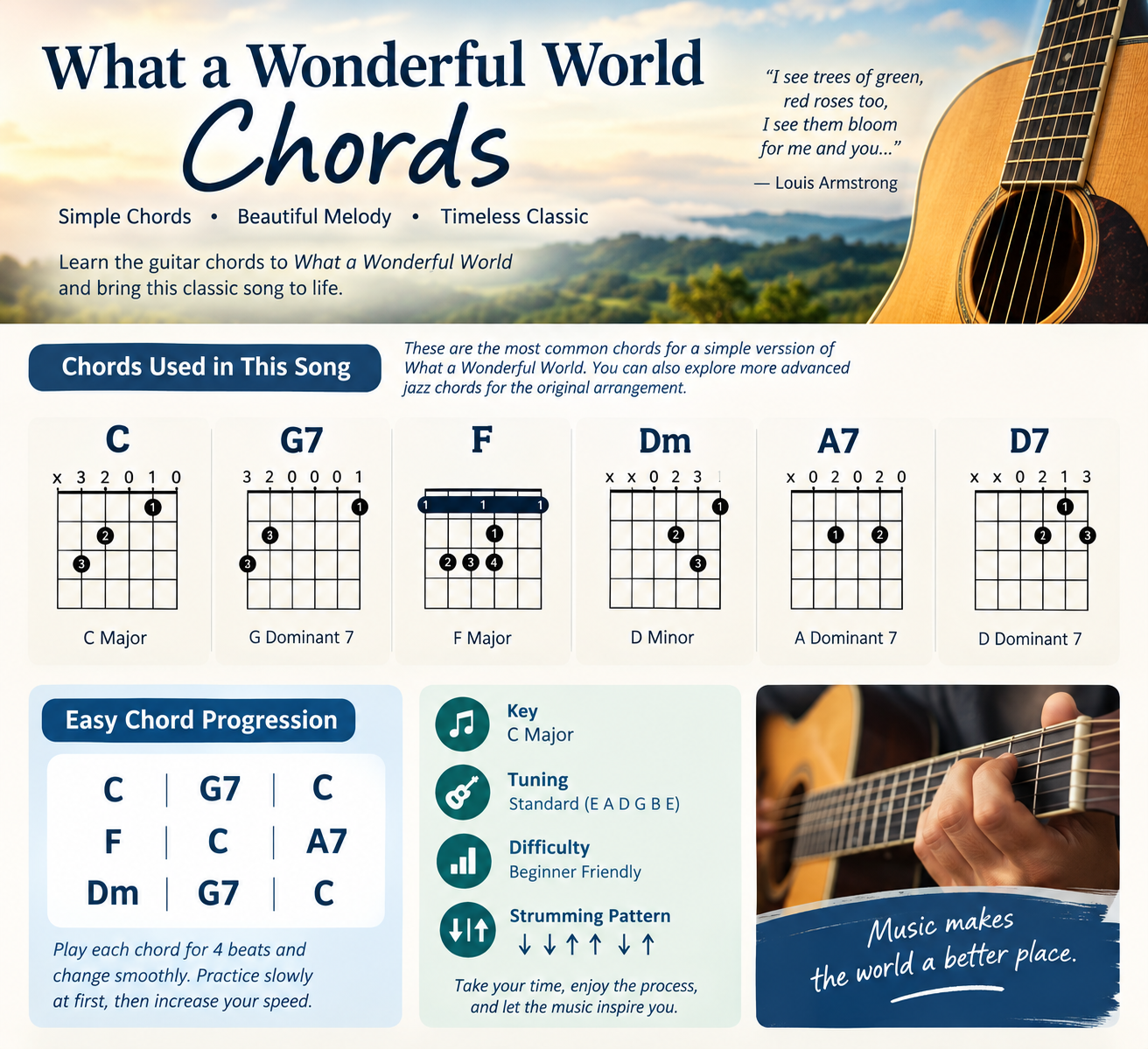
SEO Focus Keyword: What a Wonderful World chords
What a Wonderful World is a timeless song made famous by Louis Armstrong. Its gentle melody, warm harmony, and positive message make it a popular choice for guitar players who want to practice classic songs.
This guide explains the chord progression, playing approach, beginner techniques, and musical background in a clear, professional format. The goal is to help you understand how the song works on guitar rather than simply memorize chord names.
1. Song Overview
| Detail | Information |
|---|---|
| Song title | What a Wonderful World |
| Famous performer | Louis Armstrong |
| Original key | F major |
| Guitar tuning | Standard tuning (E–A–D–G–B–E) |
| Musical style | Traditional pop / jazz |
| Difficulty | Beginner-friendly simplified version; intermediate for original jazz voicings |
The song’s harmony is based in F major, with additional chords that add color and emotional movement. The original-style progression includes chords such as Fmaj7, Am, Bbmaj7, Gm7, A7, Dm, and C7.
ChordLines
+1
2. What Key Is What a Wonderful World In?
The original arrangement is commonly played in F major. This key gives the song its warm, melodic foundation.
For guitarists, F major can be challenging because of the barre chord. A practical alternative is to use a simplified C-major arrangement with a capo at the 5th fret, as suggested in a music theory analysis by Signals Music Studio.
Signals Music Studio
+1
Recommended Playing Options

Beginner arrangement
Easy option
Use simplified chord shapes and slow down the chord changes. A capo arrangement can make the original key easier to approach.

Original-style arrangement
Practice major seventh chords, dominant sevenths, diminished chords, and chord inversions for a richer jazz sound.
3. Essential Chords for the Song
The following chords are useful for learning a simplified version and understanding the harmonic structure. They are not a complete, synchronized chord chart for every line of the song.
| Chord | Role |
|---|---|
| F | Main major chord |
| Am | Minor chord used in the verse |
| Bb | Major chord in F major |
| Gm7 | Minor seventh chord |
| A7 | Dominant chord leading toward Dm |
| Dm | Minor chord |
| C7 | Dominant chord leading back to F |
The verse uses the movement F → Am → Bb → Am → Gm7 → F, followed by A7 → Dm. This progression is documented in chord analyses of the song.
signalsmusic.studio
+1
4. How to Practice the Chords
Step 1: Learn the basic chord shapes
Begin by practicing F, Am, Bb, and Gm7 separately. Focus on clear notes and avoid rushing between chord changes.
Step 2: Practice the chord transitions
The transition from F to Am is a useful starting point. Once comfortable, practice Am to Bb and Gm7 to F.
A practical exercise:
F  →  Am  →  Bb  →  Am
Gm7 → F   →  A7  →  Dm
Play each chord slowly, using four steady beats per chord as a practice exercise. This is a learning arrangement, not a claim that every chord receives four beats in the original recording.
Step 3: Add a gentle rhythm
Start with simple downstrokes:
↓   ↓   ↓   ↓
1   2   3   4
After your chord changes become comfortable, experiment with a soft down-up pattern. The song’s relaxed character benefits from controlled rhythm rather than aggressive strumming.
5. Understanding the Jazz Chords
One reason What a Wonderful World sounds more sophisticated than a basic three-chord song is its harmonic detail.
Major Seventh Chords
Chords such as Fmaj7 and Bbmaj7 introduce a smooth, colorful quality. They are commonly used in jazz and traditional pop arrangements.
The A7 Chord
A7 provides harmonic tension before the Dm chord. In music theory, it functions as a secondary dominant, helping create movement toward D minor.
Signals Music Studio
The Db Chord
The Db chord creates a notable harmonic change beneath the song’s title phrase. Music theory analysis identifies it as a borrowed flat-six chord in the key of F major.
Signals Music Studio
These details are useful for guitarists who want to move beyond basic open chords and explore the sound of jazz harmony.
6. Common Mistakes Beginners Should Avoid
Changing chords too quickly: Speed is less important than playing cleanly. Practice slowly until your fingers learn the movement.
Using excessive strumming force: A gentle touch is often more appropriate for the song’s character.
Ignoring chord quality: Fmaj7 and F are not identical. The added seventh note changes the sound and color of the chord.
Trying the full arrangement immediately: The original-style chart contains more advanced chord shapes and transitions. Start with a simplified arrangement, then add complexity gradually.
7. Is the Song Suitable for Beginners?
Yes, a simplified version can be a useful learning project for beginners. However, the original-style arrangement is more demanding because of its jazz chords, chromatic movement, and chord inversions.
Your learning path can look like this:
- Basic chordsLearn F, Am, Bb, and Dm.
- Smooth transitionsPractice the main verse movement at a slow tempo.
- Rhythm practiceAdd gentle strumming or fingerpicking.
- Jazz upgradesExplore Fmaj7, Bbmaj7, Gm7, and other richer chord voicings.
8. Frequently Asked Questions
What key is What a Wonderful World played in?
Is What a Wonderful World easy to play on guitar?
Can I play the song with a capo?
What chords should I learn first?