
Some words are simple, but they carry a surprisingly rich meaning. Wonderful is one of them. It can describe a person, experience, place, idea, feeling, achievement, opportunity, or even a memorable moment. It is positive, natural, and flexible enough to work in everyday conversations as well as more polished writing.
But what does wonderful actually mean? What are the best wonderful synonyms, how do you use the word correctly, and when should you choose wonderful instead of amazing, excellent, or fantastic?
This guide answers those questions in simple English and gives you practical examples you can use immediately.
What Does Wonderful Mean?
Wonderful is an adjective that generally means very good, extremely pleasant, enjoyable, or impressive.
For example:
- We had a wonderful time at the beach.
- She is a wonderful teacher.
- That was a wonderful idea.
- You did a wonderful job.
- We had a wonderful experience.
Cambridge defines wonderful as “extremely good,” while Oxford describes it as something very good, pleasant, or enjoyable.
The exact feeling can change depending on the sentence. Sometimes wonderful simply means excellent or enjoyable. In other situations, it can express genuine surprise, admiration, or a strong emotional response.
Wonderful Meaning in Simple English
In simple English, wonderful means very good or something that makes you feel happy, pleased, impressed, or excited.
Consider these examples:
Wonderful day:
A day that is especially pleasant or enjoyable.
Wonderful person:
Someone you admire, appreciate, or enjoy being around.
Wonderful experience:
An experience that creates strong positive feelings or memorable moments.
Wonderful opportunity:
A valuable or exciting chance to do something.
Wonderful place:
A place that is particularly enjoyable, attractive, interesting, or impressive.
This flexibility is one reason the word appears in so many everyday expressions. Oxford lists common combinations such as wonderful experience, wonderful place, wonderful day, wonderful book, wonderful opportunity, and wonderful time.
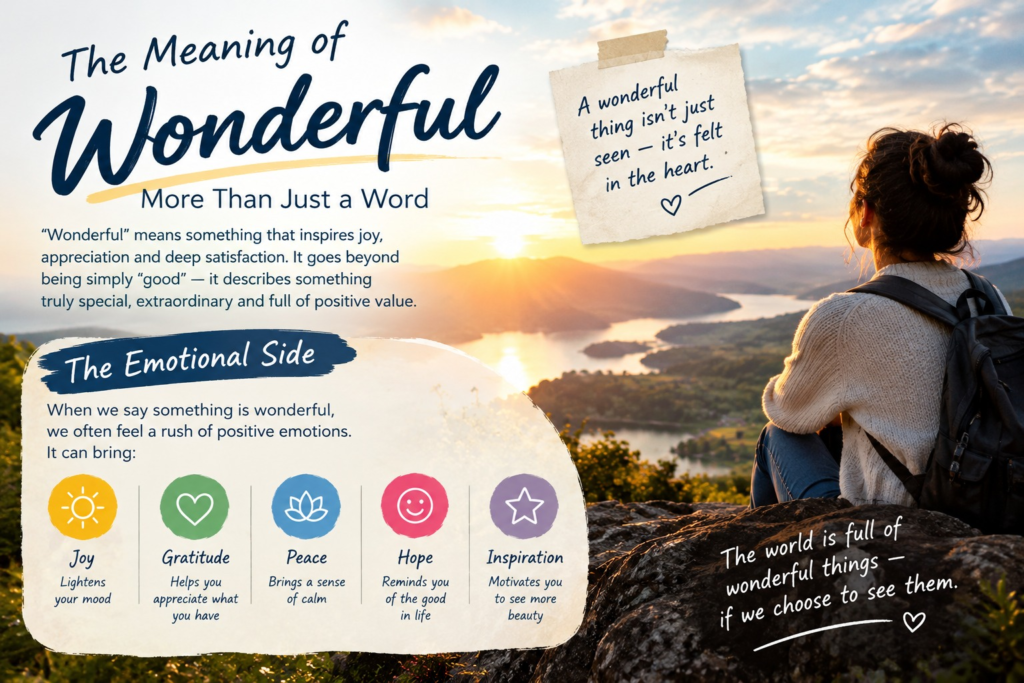
Meaning of Wonderful and Its Emotional Side
The word wonderful is not only about quality. It can also communicate emotion.
Compare:
“The restaurant was good.”
with:
“The restaurant was wonderful.”
The first statement gives a positive opinion. The second usually feels warmer and more enthusiastic.
That makes wonderful useful when you want your writing or conversation to sound appreciative without becoming overly dramatic.
You might say:
- “Thank you for a wonderful evening.”
- “It was wonderful to see you again.”
- “We made wonderful memories together.”
- “That was a wonderful surprise.”
These expressions communicate appreciation naturally.
Wonderful Synonyms
There is no single synonym that works perfectly in every situation. The best alternative depends on what you are describing and the tone you want.
Common wonderful synonyms include:
- Amazing
- Excellent
- Fantastic
- Fabulous
- Terrific
- Magnificent
- Superb
- Outstanding
- Remarkable
- Incredible
- Extraordinary
- Splendid
- Phenomenal
- Brilliant
- Tremendous
- Marvelous
- Sensational
- Admirable
- Astonishing
- Spectacular
Cambridge’s thesaurus includes words such as excellent, terrific, fabulous, fantastic, amazing, splendid, and magnificent among words related to wonderful.
However, these words are not always interchangeable.
Wonderful vs Amazing
Wonderful often emphasizes pleasure, appreciation, or positive feelings.
Amazing can emphasize surprise, wonder, or something that seems unusually impressive.
Examples:
- We had a wonderful vacation.
- The magician performed an amazing trick.
Both are positive, but the emotional emphasis is slightly different.
Wonderful vs Excellent
Excellent often focuses on quality or performance.
Wonderful can feel warmer and more personal.
For example:
- She did an excellent job on the report.
- She was a wonderful colleague.
Wonderful vs Fantastic
Fantastic is often more enthusiastic and informal.
- “We had a wonderful evening.”
- “We had a fantastic evening!”
Both sound natural. The choice depends largely on tone and personal style.
Wonderful vs Magnificent
Magnificent can suggest impressive beauty, scale, or grandeur.
- “The hotel was wonderful.”
- “The mountain view was magnificent.”
Wonderful is broader; magnificent is often more visually or emotionally grand.
Another Word for Wonderful
If you are writing repeatedly and want to avoid using wonderful too many times, consider the context before replacing it.
For a person:
- admirable
- remarkable
- excellent
- kind
- exceptional
For an experience:
- amazing
- memorable
- fantastic
- enjoyable
- extraordinary
For a place:
- beautiful
- magnificent
- spectacular
- impressive
- stunning
For an achievement:
- remarkable
- outstanding
- impressive
- exceptional
- extraordinary
This approach creates more precise writing than simply replacing wonderful with a random synonym.
How to Use Wonderful in a Sentence
Learning the word becomes easier when you see its common sentence patterns.
1. Wonderful + noun
- It was a wonderful experience.
- She had a wonderful idea.
- We enjoyed a wonderful meal.
- They planned a wonderful trip.
2. Be + wonderful
- The concert was wonderful.
- Your presentation was wonderful.
- The weather is wonderful today.
3. It is wonderful to + verb
- It is wonderful to see you.
- It was wonderful to meet everyone.
- It is wonderful to have this opportunity.
4. Wonderful + person
- He is a wonderful friend.
- She is a wonderful teacher.
- They are wonderful people.
5. Wonderful + feeling
- It was a wonderful feeling.
- Winning the competition was a wonderful experience.
- Coming home after a long trip felt wonderful.
Oxford documents several of these patterns, including constructions such as “It’s wonderful to…” and “It’s wonderful that…”.
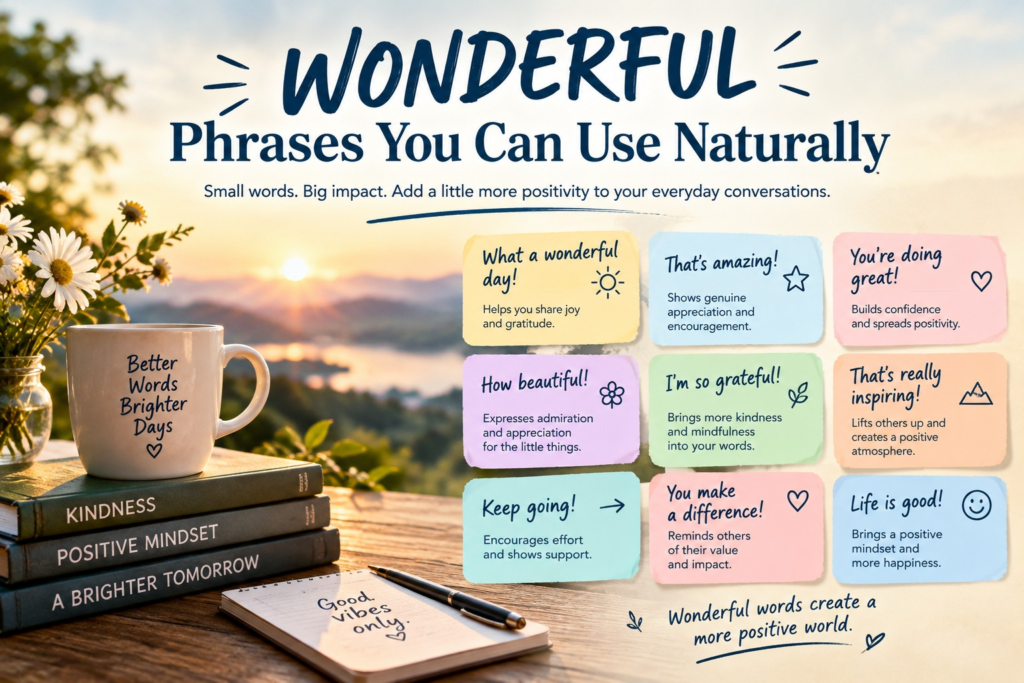
Wonderful Phrases You Can Use Naturally
Here are some useful wonderful phrases for everyday English:
- Have a wonderful day.
- Have a wonderful time.
- Have a wonderful trip.
- What a wonderful idea!
- That sounds wonderful.
- It was a wonderful experience.
- Thank you for a wonderful evening.
- You did a wonderful job.
- What a wonderful surprise!
- It is wonderful to see you.
- We had a wonderful time together.
- She has a wonderful personality.
- They created wonderful memories.
- This is a wonderful opportunity.
- It feels wonderful to be home.
These expressions are useful in conversations, emails, social messages, reviews, travel writing, and personal communication.
Wonderful Things and Wonderful Ideas
The phrase wonderful things is broad enough to describe positive events, discoveries, experiences, relationships, and opportunities.
For example:
“Travel can introduce us to wonderful things, from unfamiliar food and fascinating traditions to beautiful landscapes and new friendships.”
Similarly, wonderful ideas refers to ideas that are useful, creative, enjoyable, exciting, or particularly appealing.
For example:
“That is a wonderful idea for a weekend activity.”
The meaning comes from context rather than from a fixed definition.
Wonderful Experience: Why the Phrase Is So Common
The phrase wonderful experience is popular because it combines a general positive adjective with a noun that covers almost any memorable event.
You might describe:
- a vacation
- a concert
- a family gathering
- a restaurant visit
- a learning opportunity
- a professional event
- a new adventure
- a special celebration
For example:
“Visiting the museum was a wonderful experience because I learned something new while exploring the city’s history.”
The phrase works especially well when you want to express satisfaction without exaggerating.
Wonderful Life and Wonderful Moments
Wonderful life usually expresses appreciation for positive aspects of life, relationships, experiences, or personal achievements.
Wonderful moments focuses on individual memories or occasions.
For example:
“The photographs reminded us of the wonderful moments we shared during our journey.”
This type of language is common in personal writing because wonderful adds warmth without making the sentence complicated.
Wonderful World
The expression wonderful world can describe the beauty, variety, and surprising nature of life or the world around us.
For example:
“Books can introduce young readers to a wonderful world of imagination.”
Here, wonderful communicates curiosity and positive emotion rather than simply meaning “good.”
Wonderful Meaning in Urdu
A common Urdu translation of wonderful is:
شاندار، بہترین، شاندار اور خوشگوار، لاجواب
Depending on context, it may also be understood as:
- بہت اچھا
- نہایت عمدہ
- قابلِ تعریف
- دلکش
- حیرت انگیز
For example:
You did a wonderful job.
آپ نے بہت شاندار کام کیا۔
We had a wonderful time.
ہم نے بہت اچھا وقت گزارا۔
The exact translation should depend on the sentence rather than using one fixed Urdu word every time.
Wonderful Meaning in Hindi
In Hindi, wonderful can commonly be expressed as:
शानदार, अद्भुत, बेहतरीन, बहुत अच्छा, मनमोहक
For example:
What a wonderful idea!
क्या शानदार विचार है!
It was a wonderful experience.
यह एक शानदार अनुभव था।
Is Wonderful a Positive Word?
Yes. Wonderful is a positive adjective.
It normally communicates approval, pleasure, admiration, enjoyment, or appreciation.
For example:
- wonderful person
- wonderful opportunity
- wonderful experience
- wonderful achievement
- wonderful place
- wonderful memories
The word can also be used in an exclamation:
“How wonderful!”
This expresses happiness, approval, or pleasant surprise.
Is Wonderful an Adjective?
Yes. Wonderful is an adjective.
An adjective describes or gives information about a noun or person.
Examples:
- a wonderful book
- a wonderful teacher
- a wonderful opportunity
- a wonderful experience
- a wonderful place
The related adverb is wonderfully.
Example:
“The event was wonderfully organized.”
Wonderful Pronunciation
The word wonderful is pronounced approximately:
WUN-der-ful
IPA:
/ˈwʌn.dər.fəl/ in American English.
The stress falls on the first syllable.
Wonderful vs Excellent vs Amazing
These three words are closely related but can create slightly different impressions.
| Word | Common emphasis | Example |
|---|---|---|
| Wonderful | Pleasure, appreciation | We had a wonderful time. |
| Excellent | High quality or performance | She did an excellent job. |
| Amazing | Surprise or strong impression | The view was amazing. |
There is considerable overlap between these words, so context and tone matter more than trying to find one “perfect” replacement.
Wonderful Synonyms for Professional Writing
If you are writing a professional article, email, website, review, or business message, some alternatives may sound more precise than wonderful.
Instead of:
“We had a wonderful meeting.”
You could write:
- “We had a productive meeting.”
- “The meeting was highly informative.”
- “It was a valuable discussion.”
- “The meeting was very successful.”
Instead of:
“She did a wonderful job.”
You could write:
- “She delivered excellent work.”
- “She handled the project exceptionally well.”
- “She produced an impressive result.”
This is an important writing lesson: the strongest word is not always the best word. The most precise word is often better.
Wonderful for Everyday Conversation
In everyday English, wonderful is friendly and natural.
You can use it when responding to good news:
“I got the job!”
“That’s wonderful!”
You can use it after meeting someone:
“It was wonderful to meet you.”
You can use it when describing your plans:
“We had a wonderful weekend.”
You can also use it in polite communication:
“Thank you for the wonderful invitation.”
Its flexibility makes it useful for both casual and semi-formal communication.
How to Say Wonderful in Different Ways
If you want to express the same positive feeling without repeating wonderful, try choosing a word based on the situation.
For something impressive:
amazing, remarkable, extraordinary
For something high quality:
excellent, superb, outstanding
For something enjoyable:
delightful, enjoyable, pleasant
For something beautiful:
magnificent, spectacular, stunning
For something surprising:
astonishing, incredible, phenomenal
For something exciting:
fantastic, terrific, sensational
This gives your writing more variety while keeping the meaning natural.
Common Mistakes With Wonderful
Mistake 1: Using it for everything
If every sentence contains wonderful, the writing can become repetitive.
Instead of:
“We had a wonderful hotel, wonderful food, wonderful weather, and a wonderful trip.”
Try:
“The hotel was comfortable, the food was excellent, the weather was beautiful, and the trip became a memorable experience.”
Mistake 2: Choosing a synonym without considering tone
Magnificent, awesome, excellent, delightful, and remarkable do not always have exactly the same tone.
Choose the word that matches the subject.
Mistake 3: Keyword stuffing in online content
If you are creating an SEO article around wonderful meaning, repeatedly inserting the exact keyword can make the content unnatural.
A better approach is to cover related questions and semantic topics naturally:
- wonderful meaning
- wonderful synonyms
- another word for wonderful
- wonderful meaning in Urdu
- wonderful meaning in English
- words similar to wonderful
- wonderful vs amazing
- how to use wonderful in a sentence
- wonderful pronunciation
The goal should be to answer the reader’s questions comprehensively rather than force every keyword into every paragraph.
Frequently Asked Questions About Wonderful
What does wonderful mean?
Wonderful means very good, pleasant, enjoyable, or highly impressive. The exact sense depends on the context.
What is another word for wonderful?
Common alternatives include amazing, excellent, fantastic, magnificent, superb, remarkable, outstanding, and marvelous.
Is wonderful a positive word?
Yes. It normally expresses a positive feeling such as pleasure, admiration, approval, or appreciation.
What are the best wonderful synonyms?
Useful synonyms include excellent, amazing, fantastic, fabulous, terrific, magnificent, superb, remarkable, and extraordinary. The best choice depends on context.
What is the opposite of wonderful?
Depending on context, possible opposites include terrible, awful, unpleasant, ordinary, mediocre, or unremarkable.
How do you use wonderful in a sentence?
You can use it before a noun, after forms of “be,” or in common expressions.
Examples:
- “She is a wonderful teacher.”
- “We had a wonderful experience.”
- “That sounds wonderful.”
- “It was wonderful to see you.”
Is wonderful an adjective?
Yes. Wonderful is an adjective used to describe something very good, pleasant, enjoyable, or impressive.
What is wonderful meaning in Urdu?
Depending on context, wonderful can mean شاندار، بہترین، لاجواب، نہایت عمدہ، or حیرت انگیز.
What is wonderful meaning in Hindi?
Common Hindi equivalents include शानदार, अद्भुत, बेहतरीन, and बहुत अच्छा.
What is the difference between wonderful and amazing?
Both are positive words. Wonderful often emphasizes pleasure or appreciation, while amazing can emphasize surprise or strong admiration. The distinction depends on context.
Final Thoughts
Wonderful is a simple but versatile English word. It can describe an enjoyable experience, an impressive achievement, a kind person, a beautiful place, a valuable opportunity, or a memorable moment.
Understanding its meaning is only the first step. The real value comes from knowing when to use wonderful, when to choose a synonym, and how to make your language more precise.
If you are learning English, wonderful is a useful everyday adjective worth adding to your vocabulary. If you are writing professionally, remember that variety and precision matter. Instead of automatically replacing every repeated word with another synonym, consider what you actually want the reader to feel or understand.
That is how a simple word like wonderful becomes much more powerful in real communication.