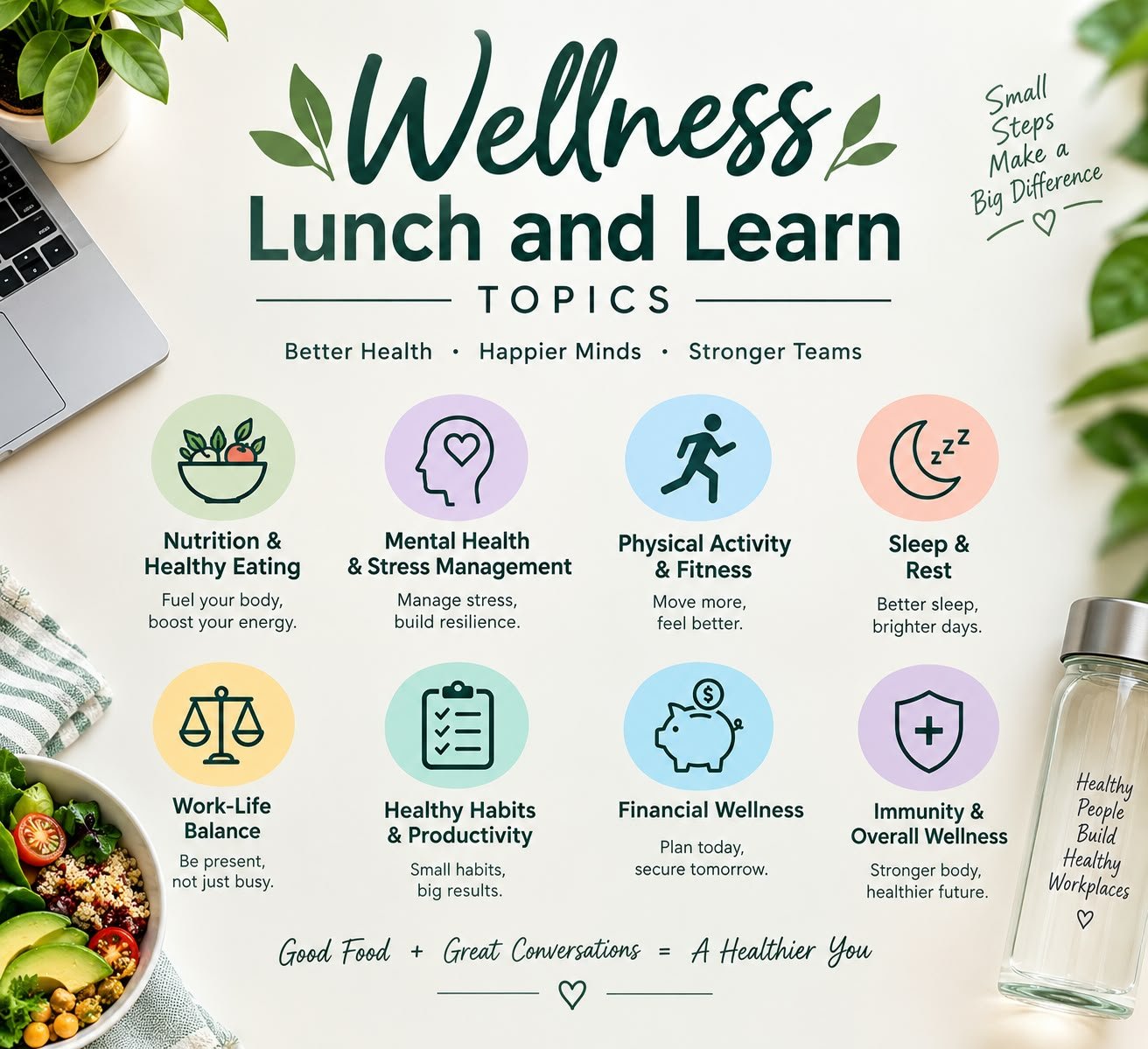
A wellness lunch and learn is more than an informal presentation during a meal. Done properly, it gives employees a short, useful opportunity to learn something they can apply to their working day, health, or personal routine.
The most effective sessions do not need to be complicated. A 30- to 60-minute discussion about sleep, workplace stress, nutrition, movement, ergonomics, financial well-being, or healthy work habits can introduce practical ideas without taking employees away from their normal responsibilities for an entire day.
Modern workplace wellness is also moving beyond the idea that employee health is simply an individual’s responsibility. The CDC’s National Institute for Occupational Safety and Health (NIOSH) takes a broader Total Worker Health approach, combining worker safety and health protection with efforts that promote overall well-being.
What Is a Wellness Lunch and Learn?
A wellness lunch and learn is a short educational session held during or around lunchtime. Employees usually attend while eating lunch, although the format can also work during a morning break or another convenient part of the workday.
The format is simple:
Learn something → discuss it → identify one practical action → return to work.
That makes the format different from a long training course. The objective is usually not to cover an entire subject. Instead, the session should give employees a clear understanding of one topic and a few realistic ideas they can use.
NIOSH has specifically included brief lunch-and-learns among practical ways organizations can integrate workplace safety, health, and well-being education.
Why the Topic Matters More Than the Presentation
A common mistake is choosing a topic because it sounds healthy rather than because employees actually need it.
For example, a company might organize a generic presentation called “Be Healthier,” but employees may actually be struggling with long periods of sitting, irregular schedules, poor sleep, workplace stress, or difficulty taking breaks.
A better approach is to ask:
- What problems do employees regularly experience?
- What health information would be useful at work?
- What can employees realistically change?
- Which workplace conditions may be contributing to the problem?
- What can managers or the organization do differently?
This last question is particularly important.
NIOSH’s workplace well-being framework considers factors beyond an individual’s personal health, including work experience, workplace policies and culture, the physical work environment, health status, and home/community circumstances.
20 Wellness Lunch and Learn Topics
1. Managing Everyday Workplace Stress
Stress is one of the most natural starting points for a workplace wellness session.
Instead of simply telling employees to “relax,” a useful presentation can explore where workplace stress comes from, how people recognize early signs of overload, and which practical strategies can help.
A session could cover:
- Identifying common workplace stressors
- Short recovery breaks
- Setting reasonable boundaries
- Prioritizing tasks
- Communication with supervisors
- When professional support may be appropriate
Importantly, stress management should not become a way of placing all responsibility on employees. NIOSH emphasizes that workplace policies and work design can influence worker well-being.
2. Better Sleep for Better Workdays
Sleep is an excellent lunch-and-learn subject because it connects personal health with everyday performance.
Topics can include:
- Consistent sleep schedules
- Evening screen habits
- Caffeine timing
- Creating a suitable sleep environment
- Shift work and fatigue
- Recognizing persistent sleep problems
For employees working irregular schedules, fatigue can be especially relevant. NIOSH identifies working hours, fatigue, shift work, and long work schedules among its workplace well-being priorities.
3. Healthy Eating When You Work Full-Time
Healthy eating at work is often less about knowing what food is nutritious and more about dealing with convenience.
This session could discuss:
- Building a balanced lunch
- Choosing practical snacks
- Reading food labels
- Preparing meals ahead
- Eating during busy workdays
- Making healthier choices when ordering food
Rather than promoting a restrictive diet, the presentation can focus on realistic food decisions employees can make during a normal working week.
4. Desk Job Health: Move More Without Leaving Your Job
This is particularly useful for office-based teams.
Employees can learn about:
- Breaking up long sitting periods
- Walking during short breaks
- Standing periodically
- Simple workplace movements
- Taking stairs when appropriate
- Building movement into meetings
The topic is easy to turn into an interactive session because employees can immediately identify how much of their working day is spent sitting.
5. Workplace Ergonomics
Ergonomics can make a strong technical wellness topic.
A session could explain:
- Desk and monitor positioning
- Chair setup
- Keyboard and mouse placement
- Neck and shoulder positioning
- Lighting
- Laptop use
- Repetitive tasks
Rather than simply giving employees an ergonomic checklist, invite them to examine their own workstations and identify one adjustment they can make.
6. Mental Health at Work
Mental health deserves a place in workplace wellness programs without turning a lunch session into therapy.
A professional session might discuss:
- Mental health awareness
- Recognizing when someone may need support
- Reducing stigma
- Healthy communication
- Available workplace resources
- When to seek professional help
NIOSH identifies mental health as an important component of worker well-being and supports approaches that address workplace conditions as well as individual needs.
7. Preventing Burnout
Burnout can be discussed from two directions: individual habits and organizational conditions.
Employees can learn about workload awareness, recovery, boundaries, and recognizing persistent exhaustion.
Managers can also learn how workload, staffing, communication, scheduling, and workplace culture may contribute to problems.
NIOSH specifically states that organizational changes are important when addressing workplace burnout and that individual self-care alone is not sufficient.
8. Building a Healthier Workday
This topic works well for a general employee audience.
Instead of discussing one medical subject, the session can follow an employee through a typical workday:
Morning → commuting → work → lunch → afternoon → leaving work → evening.
At each point, participants can identify one healthier option.
This makes the subject practical rather than theoretical.
9. Hydration at Work
A short session can focus entirely on hydration habits.
Topics could include:
- Why people sometimes forget to drink
- Keeping water accessible
- Recognizing personal hydration needs
- Choosing beverages thoughtfully
- Creating simple reminders
The advantage of this topic is its simplicity. It can be covered in 20–30 minutes without overwhelming participants.
10. Healthy Habits for Remote Workers
Remote work creates its own wellness challenges.
A lunch and learn could address:
- Creating boundaries between work and personal time
- Taking movement breaks
- Avoiding working from bed
- Setting up a comfortable workstation
- Maintaining social connection
- Creating a clear end-of-work routine
The goal should not be to make remote workers follow an office-style schedule. It should help them design a healthier working environment at home.
11. Financial Wellness
Financial stress can affect an employee’s overall sense of well-being.
A session might introduce:
- Basic budgeting
- Emergency savings
- Understanding workplace benefits
- Managing recurring expenses
- Avoiding unnecessary financial pressure
- Where to obtain professional financial guidance
This topic broadens wellness beyond physical health.
12. Digital Wellness
Employees spend a large part of their day around screens.
A digital wellness session could discuss:
- Notification overload
- Constant email checking
- Screen breaks
- Phone-free periods
- Healthy boundaries after work
- Separating urgent communication from non-urgent communication
This is particularly relevant for organizations where employees remain connected outside normal working hours.
13. Healthy Communication and Workplace Relationships
Wellness is also influenced by how people interact.
The session could cover:
- Listening skills
- Respectful disagreement
- Clear communication
- Giving constructive feedback
- Asking for help
- Maintaining professional boundaries
NIOSH’s worker well-being framework includes workplace culture and work experience among the areas that contribute to overall well-being.
14. Nutrition for Energy During the Workday
Instead of promoting “energy foods,” focus on practical eating patterns.
Discuss:
- Balanced meals
- Protein and fiber
- Fruits and vegetables
- Regular eating patterns
- Excessive sugary drinks
- Heavy lunches and afternoon tiredness
Employees can finish the session by creating one realistic lunch idea for their next workday.
15. Healthy Habits for Shift Workers
Shift workers have different challenges from traditional nine-to-five employees.
A dedicated session could cover:
- Sleep timing
- Fatigue
- Meal planning
- Light exposure
- Safe commuting after long shifts
- Managing changing schedules
This is a particularly useful topic for healthcare, manufacturing, transportation, hospitality, and other industries with non-standard schedules.
16. Workplace Safety and Personal Well-Being
Safety and wellness should not always be treated as separate subjects.
A session could connect:
Safety → fatigue → concentration → work environment → health → well-being.
This reflects the broader Total Worker Health approach used by NIOSH, which integrates protection from workplace hazards with health promotion and prevention.
17. Building Healthy Routines That Actually Last
Many employees have tried health programs before.
This session can focus on why habits disappear and how to make them more realistic.
Discuss:
- Starting small
- Linking a new habit to an existing routine
- Making healthy choices convenient
- Tracking progress without obsession
- Recovering after setbacks
- Avoiding all-or-nothing thinking
This can be one of the most relatable topics because it deals with everyday behavior rather than idealized lifestyles.
18. Understanding Your Workplace Well-Being
Instead of asking employees only whether they “feel healthy,” organizations can take a broader view.
NIOSH’s WellBQ assesses worker well-being across five domains: work evaluation and experience, workplace policies and culture, physical environment and safety climate, health status, and home/community/society.
A lunch and learn can introduce this broader idea and encourage employees to think about what actually affects their well-being at work.
19. Creating a Healthier Workplace Culture
Wellness should not exist only as an employee responsibility.
This topic can explore:
- Leadership behavior
- Employee feedback
- Workload
- Scheduling
- Communication
- Psychological safety
- Break culture
- Respect in the workplace
NIOSH’s Total Worker Health approach specifically emphasizes healthy work design and organizational policies alongside individual health promotion.
20. Personal Wellness Plan: One Change at a Time
This can work particularly well as the final session in a wellness series.
Employees can choose one area:
Sleep | Food | Movement | Stress | Relationships | Digital habits | Preventive care
Then create a small action they can realistically try during the following week.
The emphasis should be on a manageable change rather than a complete lifestyle overhaul.
What Makes a Wellness Lunch and Learn Different?
A good session should not feel like a lecture.
Consider using a simple structure:
5 Minutes — Opening
Introduce the topic and explain why it matters.
10 Minutes — Useful Information
Give employees a few evidence-based facts.
10 Minutes — Real Workplace Examples
Discuss situations employees actually encounter.
10 Minutes — Interactive Activity
Use a poll, short exercise, workstation check, discussion, or personal reflection.
5 Minutes — One Action
Ask each participant to identify one practical step they can take.
This keeps the session focused.
A Different Way to Measure Success
Attendance alone does not tell you whether a wellness lunch and learn was useful.
Instead, organizations can ask:
- Did employees find the information relevant?
- Did they learn something new?
- Did they identify an action they can take?
- Did they know where to find additional support?
- Did the session reveal a workplace problem?
- Did employees feel comfortable providing feedback?
For larger wellness programs, organizations can use structured tools. NIOSH’s WellBQ is designed to assess worker well-being holistically and can help organizations identify areas where workplace interventions may be useful.
NIOSH also provides workplace wellness toolkits intended to help organizations plan, assess, implement, and evaluate workplace health and well-being initiatives.
The Most Important Idea
The strongest wellness lunch and learn is not necessarily the one with the most slides.
It is the one that connects useful information with the reality of the workplace.
If employees are exhausted, discuss fatigue and work design.
If they sit all day, discuss movement and ergonomics.
If they struggle with stress, discuss both individual coping strategies and workplace causes.
If employees are interested in nutrition, give them practical food strategies rather than another list of “superfoods.”
If managers are concerned about burnout, discuss organizational factors instead of telling employees simply to practice more self-care.
That approach reflects the broader modern understanding of workplace well-being: employee health is influenced by both individual behavior and the conditions in which people work.
Final Thoughts
Wellness lunch and learn topics should be practical, evidence-informed, and relevant to real working life.
The best sessions do not promise instant transformation. They give employees useful information, create an opportunity for discussion, and provide a realistic next step.
A workplace wellness program can begin with something as simple as a lunch, a conversation, and one useful idea that an employee can take back into the rest of their day