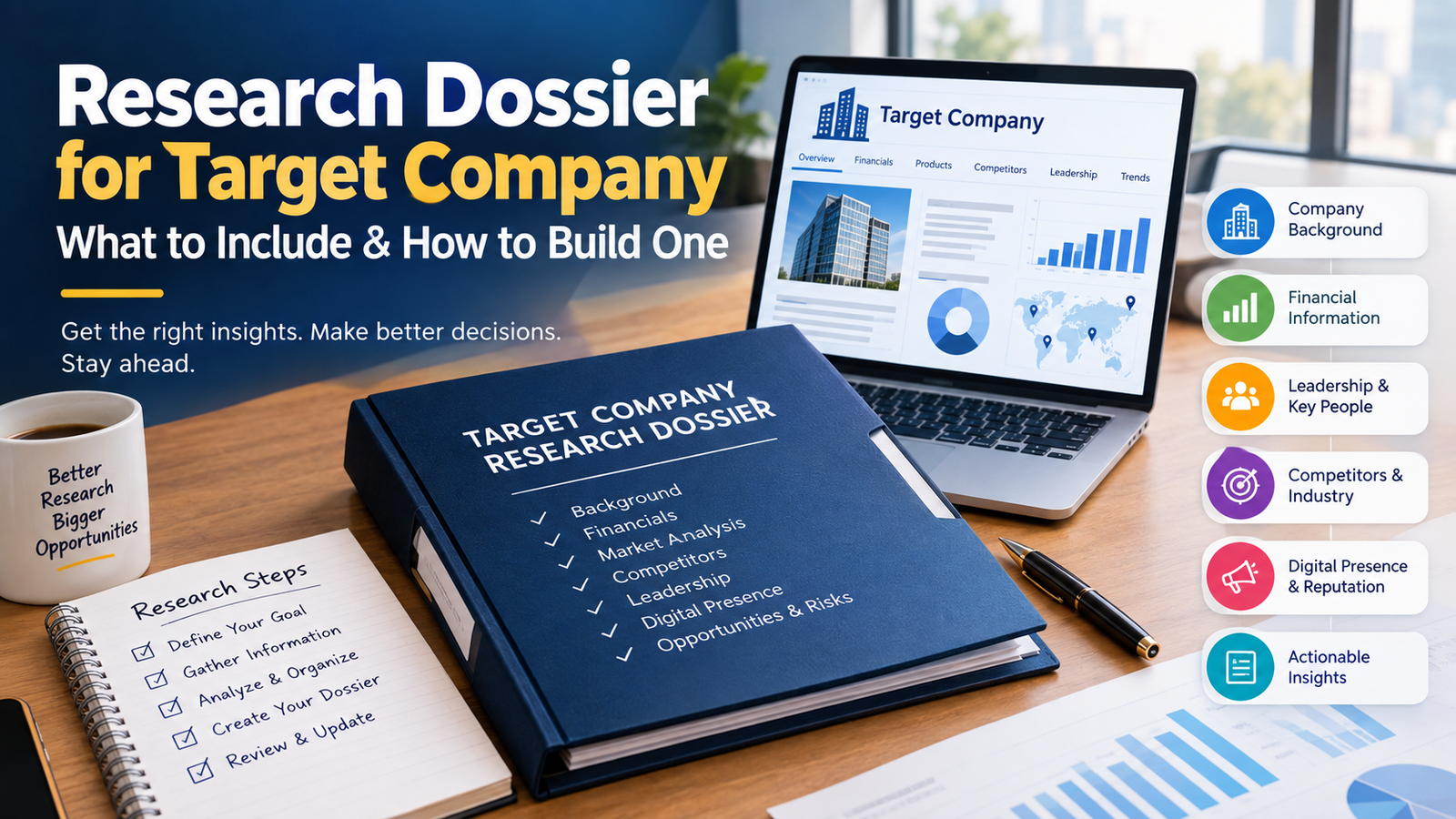
A research dossier for target company brings important business information into one organized profile so you can understand a company before making a professional decision. Instead of collecting scattered details from different sources, a well-prepared dossier turns company research into a clear, practical, and decision-ready document.
Whether you are researching a potential client, competitor, supplier, investment opportunity, business partner, employer, or acquisition target, the right company dossier can reveal information that a basic company search often misses.
This guide explains what a research dossier is, what it should contain, how to prepare one, and how businesses can use company intelligence to make more informed decisions.
Table of Contents
- What Is a Research Dossier for a Target Company?
- Why Company Research Matters
- What Should a Company Research Dossier Include?
- Target Company Background Research
- Financial and Business Information
- Products, Services and Market Position
- Leadership and Key People
- Competitor and Industry Research
- Digital Presence and Online Reputation
- Company Research Dossier Template
- How to Build a Research Dossier
- Common Research Mistakes
- Who Uses Company Research Dossiers?
- FAQs
- Final Thoughts
What Is a Research Dossier for a Target Company?
A research dossier for a target company is a structured collection of information about a specific business. It can include the company’s background, ownership, leadership, products, services, financial information, market position, competitors, customers, digital presence, reputation, and relevant business developments.
The main purpose is simple: turn raw company information into useful business intelligence.
A basic company profile may only provide an overview. A detailed research dossier goes further by connecting different pieces of information and presenting them in a format that supports research, sales, investment, competitive analysis, due diligence, or strategic planning.
Why Company Research Matters
Strong company research can save time and reduce avoidable business mistakes. Before approaching a company, investing in it, partnering with it, or competing against it, you need to understand how the organization actually operates.
A detailed target company research report can help answer questions such as:
- Who owns and manages the company?
- What does the company sell?
- Who are its customers?
- What market does it serve?
- Who are its major competitors?
- How strong is its online presence?
- What opportunities or risks may exist?
- What recent developments could affect the business?
The answers become much more useful when they are organized into one reliable research document.
What Should a Company Research Dossier Include?
A professional company dossier should be customized according to the research objective. A sales team may need different information than an investor or competitor.
However, most comprehensive dossiers can be organized around several core areas.
| Research Area | Information to Examine | Business Purpose |
|---|---|---|
| Company Profile | Name, location, history, business model | Understand the organization |
| Leadership | Executives, founders, key decision-makers | Identify important contacts |
| Products & Services | Main offerings and value proposition | Understand what the company sells |
| Market | Industry, audience, geographic reach | Evaluate market position |
| Financials | Revenue indicators, funding, growth signals | Assess business strength |
| Competitors | Direct and indirect competitors | Understand competitive landscape |
| Digital Presence | Website, search visibility, social channels | Evaluate online positioning |
| Reputation | Reviews, media coverage, public feedback | Identify perception and risks |
| Opportunities | Gaps, weaknesses, market needs | Support strategic decisions |
The depth of each section should depend on the purpose of the dossier rather than simply making the document longer.
Target Company Background Research
A strong dossier starts with the company’s basic identity. This section creates the foundation for everything that follows.
Research the company’s official name, business location, founding history, operating markets, business structure, industry, and major milestones. If the organization has multiple brands or subsidiaries, those relationships should also be clearly identified.
Company history can provide valuable context. A business that recently expanded, changed ownership, launched a new product line, or entered a new market may require a very different research approach from a mature company with an established market position.
Company Profile Information
A useful company profile may include:
- Company name and business type
- Headquarters and operating locations
- Founding date and history
- Parent company or subsidiaries
- Main products or services
- Target customers
- Geographic markets
- Business model
- Major milestones
The goal is not simply to collect facts. The goal is to understand what the company is, what it does, and where it is heading.
Financial and Business Information
Financial research can make a company dossier considerably more valuable, particularly for investment, acquisition, partnership, and due-diligence purposes.
Publicly available information may provide useful indicators such as company growth, funding activity, acquisitions, major contracts, market expansion, or changes in business strategy. For public companies, financial filings can provide considerably more detail than ordinary company profiles.
Private companies require more careful interpretation because financial information may be limited. In those situations, researchers should distinguish verified information from estimates, third-party claims, or assumptions.
A professional dossier should never present an estimate as a confirmed financial fact.
Products, Services and Market Position
Understanding what the target company sells is essential for meaningful research.
Start by examining its primary products and services. Then consider the customers those offerings serve, the problems they solve, pricing or positioning where available, and the company’s main value proposition.
This information becomes especially useful when conducting competitor research. Two businesses may appear to compete in the same industry but actually target different customer segments.
A good target company research report therefore examines positioning rather than simply listing products.
Market Position
Market research should consider the company’s geographic reach, customer segment, industry specialization, brand positioning, and apparent competitive advantages.
Search visibility can also provide useful clues. A company ranking strongly for commercially important searches may have a different digital strategy from a company relying primarily on referrals, partnerships, marketplaces, or offline sales.
Leadership and Key People
People often provide important clues about a company’s direction.
A research dossier should identify founders, executives, senior managers, and other publicly documented decision-makers when they are relevant to the research objective.
Leadership research can reveal changes in management, previous companies, professional backgrounds, strategic responsibilities, and public statements.
For sales research, identifying the right decision-maker can make outreach considerably more relevant. For competitive research, leadership changes may help explain shifts in products, branding, expansion, or business strategy.
Competitor and Industry Research
No company exists in isolation. A meaningful company research dossier should therefore examine the competitive environment around the target.
Start by identifying direct competitors that offer similar products or services to the same customer segment. Then consider indirect competitors that solve the same customer problem in a different way.
Industry research should examine market trends, customer expectations, emerging technologies, changing regulations where relevant, and new business models.
Competitive Comparison
A simple competitive analysis can compare factors such as:
- Products and services
- Target customers
- Geographic coverage
- Pricing position
- Brand messaging
- Search visibility
- Content strategy
- Customer reviews
- Strengths and apparent gaps
The purpose is not to declare a winner. It is to understand where the target company fits within its competitive environment.
Digital Presence and Online Reputation
A company’s digital footprint can reveal a great deal about its visibility and communication strategy.
Start with the official website and examine its structure, content, product pages, service pages, contact information, location targeting, and overall messaging.
Then review relevant social media profiles, business listings, industry directories, review platforms, news coverage, and other publicly available digital references.
For SEO research, pay particular attention to the topics and search terms associated with the company. Content gaps can reveal areas where the business has opportunities to provide more useful information to potential customers.
Online Reputation
Reputation research should distinguish between verified information and individual opinions.
Customer reviews can reveal recurring themes around service quality, support, pricing, delivery, or customer experience. However, individual reviews should not automatically be treated as representative of the entire organization.
Looking for repeated patterns across multiple credible sources provides a stronger basis for interpretation.
Research Dossier for Target Company Template
A practical dossier can follow a simple structure that keeps the information easy to navigate.
1. Executive Summary
Start with a concise overview of the target company, its industry, major offerings, market presence, and the purpose of the research.
2. Company Overview
Describe the company’s history, business model, locations, ownership structure where available, and major developments.
3. Products and Services
Explain the company’s core offerings and the customers or industries they serve.
4. Leadership
Document relevant executives, founders, and decision-makers using reliable public information.
5. Market Analysis
Explain the company’s target market, geographic reach, industry environment, and positioning.
6. Competitive Landscape
Identify relevant competitors and compare their positioning, offerings, and visible market presence.
7. Digital Analysis
Review website content, search visibility, social presence, online listings, and digital reputation.
8. Business Opportunities and Risks
Highlight research-supported opportunities, challenges, market gaps, or developments that may deserve additional investigation.
9. Sources and Verification
Record where important information came from and identify information that could not be independently verified.
How to Build a Research Dossier
Building a useful dossier requires more than searching the company name and copying the first results.
Begin by defining the purpose of the research. A sales dossier, investment dossier, competitor dossier, and due-diligence dossier will each require different levels of detail.
Next, establish the company’s identity and collect primary information. Official company materials, regulatory records, public filings, reputable industry publications, and other authoritative sources should receive appropriate weight.
After gathering the information, organize it into logical sections. Separate confirmed facts from estimates and interpretations. This step is particularly important because online company information can become outdated quickly.
Finally, review the dossier for consistency. Company names, leadership roles, locations, dates, ownership details, and financial information should be checked before the document is used for an important business decision.
Common Research Mistakes
Poor company research often comes from relying too heavily on one source or confusing online claims with verified information.
Another common problem is collecting too much information without identifying what actually matters. A 50-page document is not automatically better than a focused 10-page dossier.
Avoid these problems:
- Relying on outdated company information
- Treating estimates as confirmed facts
- Copying information without verification
- Ignoring competitors and market context
- Mixing opinions with factual findings
- Failing to identify the research date
- Collecting information without a clear business purpose
The best dossier is accurate, organized, relevant, and actionable.
Who Uses Company Research Dossiers?
A research dossier can support many different professional activities.
Sales teams use company intelligence to understand prospects before outreach. Marketing teams use it to identify market opportunities and competitor strategies. Investors and analysts use company research to understand businesses before further evaluation. Recruiters can use public company information to understand prospective employers or clients.
Business development teams can also use dossiers to prepare for partnerships, negotiations, strategic meetings, and account planning.
For SEO professionals, a company research dossier can become the starting point for a deeper digital competitor analysis, content strategy, topical authority assessment, and search opportunity review.
FAQs About Research Dossiers
What is a research dossier for a target company?
It is an organized research document containing important information about a specific company, including its background, leadership, products, market, competitors, digital presence, and other relevant business intelligence.
Why create a target company research dossier?
The main purpose is to make company information easier to understand and use. It can support sales, marketing, investment research, competitive analysis, partnerships, and business planning.
What sources should be used for company research?
Use reliable and relevant sources such as official company information, regulatory records, public filings, reputable industry publications, and credible business databases. The appropriate sources depend on the type of research being performed.
How long should a company research dossier be?
There is no universal length. A focused prospecting dossier may be relatively short, while investment research or detailed due diligence can require substantially more information.
Can a research dossier include competitor analysis?
Yes. Competitor analysis is often one of the most useful sections because it places the target company’s products, positioning, visibility, and market activity into context.
What is the difference between a company profile and a research dossier?
A company profile generally provides a concise overview. A research dossier is usually broader and more analytical, bringing together multiple categories of information for a specific research objective.
Final Thoughts
A well-prepared research dossier for target company transforms scattered business information into a structured source of intelligence. The real value does not come from simply collecting facts; it comes from organizing relevant information, checking its reliability, understanding the surrounding market, and connecting the findings to a clear business purpose.
Whether the goal is prospect research, competitive analysis, investment research, partnership preparation, or SEO planning, a carefully structured company dossier provides a stronger foundation for the next decision.
The most effective approach is to keep the research focused, distinguish verified facts from assumptions, prioritize credible information, and update important findings as the company and market change.